
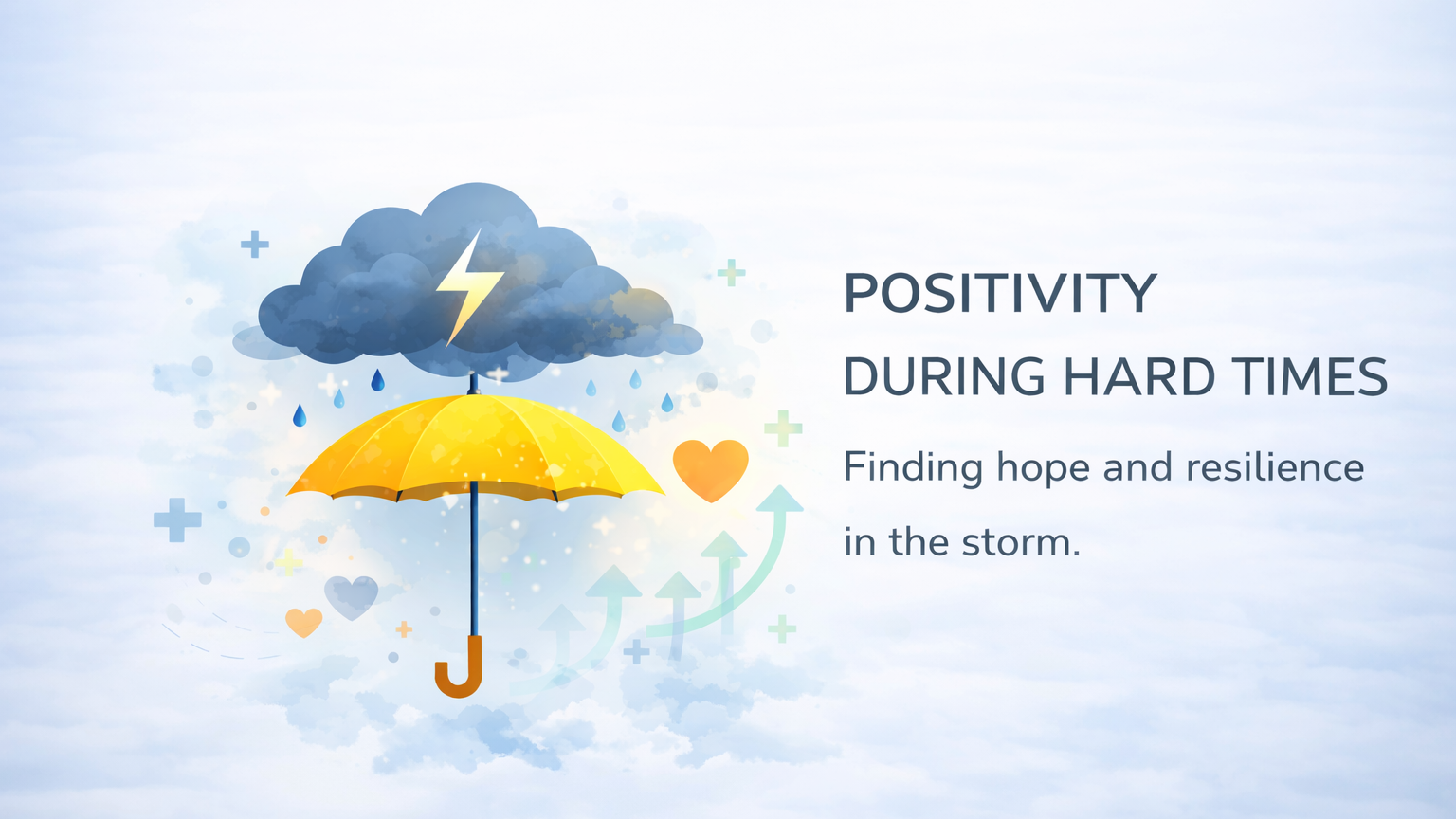
POSITIVITY DURING HARD TIMES
-
When life is going well, positivity feels natural.
When life is hard, positivity can feel unrealistic — or even impossible.This is where many people give up on the idea of staying positive altogether. They assume positivity is something meant for “better seasons,” not for moments filled with stress, loss, uncertainty, or exhaustion.
But positivity during hard times is not about pretending everything is okay.
It is about learning how to hold onto strength, clarity, and hope when things are not okay.
This article is not about forcing optimism or ignoring pain. It is about understanding what positivity truly looks like when life feels heavy — and how to practice it in a way that supports you instead of draining you.
First, Let’s Be Honest About Tough Times
Tough times affect people differently.
For some, it’s loss.
For others, it’s uncertainty, financial stress, health struggles, emotional exhaustion, or feeling stuck in a season that won’t seem to end.During these times:
motivation drops
negative thoughts increase
energy feels limited
emotions feel more intense
hope can feel distant
None of this means you are weak.
It means you are human.Staying positive during tough times does not mean ignoring these realities — it means learning how to live with them without letting them completely take over.
What Staying Positive During Hard Times REALLY Means
Staying positive during difficult seasons does not mean:
being cheerful
pretending things don’t hurt
pushing emotions away
acting like everything is fine
It means choosing to:
face reality honestly
respond with intention instead of despair
protect your mindset while you navigate difficulty
believe that this season is not the end of your story
Positivity during hardship is quieter, steadier, and more grounded than positivity during ease.
Why Positivity Feels Harder When Life Is Heavy
Hard times demand more emotional energy.
Your mind shifts into survival mode. It becomes more focused on:
potential threats
worst-case outcomes
past mistakes
fear of the future
This is not a personal failure — it is how the brain responds to stress.
Understanding this is important, because it removes guilt from the process. If positivity feels harder right now, it’s not because you’re failing — it’s because you’re carrying more weight.
Positivity During Hard Times Starts With Allowing Reality
One of the most damaging myths about positivity is the idea that you must suppress negative emotions to stay positive.
In reality, the opposite is true.
You cannot build a positive mindset on top of emotional denial.
Staying positive during hard times begins with allowing yourself to say:
“This is hard.”
“I don’t understand why this is happening.”
“I feel tired, overwhelmed, or discouraged.”
Acknowledging pain does not weaken positivity — it stabilizes it.
Choosing Positivity in Small, Manageable Ways
During difficult seasons, positivity should be scaled to what you can realistically carry.
This may look like:
focusing on one small thing you can control
taking the next right step instead of planning the whole future
choosing calm over chaos in one moment
speaking kindly to yourself when you make mistakes
Positivity during hard times is built through small decisions, not grand transformations.
The Power of Perspective Without Minimizing Pain
A positive mindset during tough times does not minimize pain — it reframes it.
Reframing does not ask:
“Why isn’t this a big deal?”
It asks:
“What can I do with this moment?”
“What is still within my control?”
“What does this situation not get to take from me?”
Perspective gives pain boundaries. It keeps hardship from becoming identity.
Staying Positive Without Falling Into Toxic Positivity
One of the biggest dangers during tough times is toxic positivity.
This happens when positivity is used to avoid discomfort instead of navigate it.
Healthy positivity says:
“This hurts, and I’m still moving forward.”
Toxic positivity says:
“I shouldn’t feel this way.”
During hard times, positivity must include compassion — not pressure.
Protecting Your Mind During Difficult Seasons
Hard times make the mind vulnerable to:
negative self-talk
hopeless thinking
catastrophic thinking
emotional exhaustion
Protecting your mindset means:
limiting constant negative input
creating moments of mental rest
surrounding yourself with supportive voices
reducing unnecessary stressors when possible
Protecting your mind is not avoidance — it is self-preservation.
Why Staying Positive Makes Tough Times Easier to Carry
Positivity does not remove hardship — but it changes how heavy it feels.
When positivity is present:
emotions are less overwhelming
decisions feel clearer
setbacks feel temporary instead of permanent
energy is used more wisely
Positivity acts like a stabilizer during turbulence. It doesn’t stop the storm — but it keeps you grounded.
What Staying Positive Looks Like on the Hardest Days
Some days, staying positive means:
getting out of bed
showing yourself grace
choosing not to give up
resting instead of pushing
believing tomorrow might be different
These are not small wins — they are acts of resilience.
When Positivity Feels Impossible
There will be moments when positivity feels out of reach.
During those moments:
focus on staying present, not positive
focus on breathing, not fixing
focus on survival, not growth
Positivity returns when the pressure to perform it is removed.
Final Reflection
Staying positive through tough times does not mean you are unaffected by pain.
It means you are choosing not to let pain define you.
It means believing — even quietly — that this season is not permanent, and that strength can exist alongside struggle.
At Alpha Positivity, we believe that real positivity shows up not when life is easy — but when life is hard, and you choose to keep going anyway.
And sometimes, that choice alone is enough.
-
There are seasons in life when everything feels heavier than it should.
Getting out of bed takes effort.
Simple tasks feel draining.
Your thoughts feel slower, louder, or more overwhelming.
And even when nothing dramatic is happening, the weight is still there.When life feels heavy, the hardest part is not always the situation itself — it’s the quiet exhaustion that comes with carrying it day after day.
This article is not about pushing through at all costs.
It’s not about pretending things are fine.
And it’s not about finding motivation where there is none.It’s about learning how to keep going gently, honestly, and sustainably when life feels heavier than usual.
First, Let’s Acknowledge the Weight
When life feels heavy, many people try to explain it away.
They tell themselves:
“Others have it worse.”
“I should be grateful.”
“I shouldn’t feel this way.”
But heaviness does not require justification.
You don’t need a dramatic reason to feel tired, overwhelmed, or emotionally worn down. Life can feel heavy simply because you’ve been carrying a lot for a long time.
Acknowledging the weight is not weakness — it’s self-awareness.
And self-awareness is where real strength begins.
Why Life Feels Heavy Sometimes
Life feels heavy when:
stress becomes chronic
uncertainty lasts too long
emotional needs go unmet
you’re constantly adapting without rest
expectations exceed energy
hope feels distant or delayed
Heaviness often builds gradually. It’s not always tied to one event — it’s the accumulation of many small pressures over time.
Understanding this helps remove self-blame. You’re not failing — you’re responding to sustained emotional load.
Keeping Going Does Not Mean Pushing Harder
One of the biggest misconceptions about resilience is the idea that keeping going means pushing harder.
When life feels heavy, pushing harder often leads to:
burnout
emotional numbness
resentment
deeper exhaustion
Keeping going does not mean forcing productivity or pretending strength.
Sometimes, keeping going means adjusting how you move forward, not whether you move forward at all.
Redefining What “Going” Means
During heavy seasons, progress looks different.
Keeping going might mean:
doing less, but doing it intentionally
slowing down without giving up
choosing rest instead of pressure
surviving today instead of fixing everything
Progress during hard times is not measured by speed — it’s measured by continuation.
The Importance of Self-Compassion When Life Is Heavy
When energy is low, self-criticism often gets louder.
Thoughts like:
“I should be handling this better.”
“Why am I so tired?”
“I’m falling behind.”
These thoughts add weight instead of removing it.
Self-compassion does the opposite.
It says:
“This is hard, and I’m doing my best.”
“It’s okay to move slowly.”
“I don’t need to punish myself to keep going.”
Self-compassion doesn’t remove responsibility — it removes unnecessary suffering.
Breaking Life Into Smaller Pieces
When life feels heavy, thinking too far ahead can become overwhelming.
Instead of focusing on:
the entire week
the long-term outcome
everything that still needs to be done
Focus on:
the next hour
the next small task
the next moment of relief
Keeping going often means shrinking your focus, not expanding it.
The Power of Showing Up Imperfectly
Many people stop moving forward because they believe they need to feel better before they act.
But action often comes before motivation, not after.
Showing up imperfectly still counts.
Trying while tired still counts.
Moving forward slowly still counts.You don’t need to feel strong to keep going — you only need to stay present.
When Your Mind Feels Just as Heavy as Your Circumstances
Emotional heaviness often comes with mental heaviness.
This can include:
negative self-talk
rumination
fear of the future
replaying past mistakes
During these times, keeping going mentally may mean:
pausing instead of spiraling
grounding yourself in the present
reminding yourself that thoughts are not commands
allowing silence instead of noise
Mental rest is just as important as physical rest.
Why Connection Matters When Life Feels Heavy
Heaviness thrives in isolation.
Even when you don’t feel like talking, safe connection can:
lighten emotional load
bring perspective
reduce shame
remind you that you’re not alone
Keeping going does not mean carrying everything by yourself.
Asking for support is not a failure — it’s wisdom.
Giving Yourself Permission to Rest Without Quitting
Rest is not quitting.
Rest is how you regain strength without abandoning yourself.
Rest may look like:
taking a break without guilt
stepping back from expectations
allowing stillness
prioritizing recovery over productivity
You don’t lose progress by resting — you preserve it.
When Hope Feels Quiet or Absent
There may be moments when hope feels distant.
In those moments, don’t aim for hope — aim for stability.
Stability looks like:
breathing through the moment
staying grounded
choosing not to give up today
Hope often returns when the pressure to feel hopeful is removed.
Keeping Going Is Sometimes an Act of Courage
When life feels heavy, simply continuing is not ordinary — it’s brave.
Showing up when you’re tired.
Choosing not to quit when quitting feels tempting.
Holding on when answers aren’t clear.These are not small things.
They are acts of courage.
Final Reflection
Keeping going when life feels heavy does not require strength you don’t have.
It requires:
honesty
patience
self-compassion
presence
You don’t need to move fast.
You don’t need to have answers.
You don’t need to feel okay yet.You only need to keep choosing yourself — gently, imperfectly, and one moment at a time.
At Alpha Positivity, we believe that sometimes the strongest thing you can do is keep going without abandoning yourself.
And that choice, repeated quietly, is enough.
-
One of the hardest moments in life is not when something goes wrong —
it’s when something goes wrong and there is no clear reason why.No explanation.
No obvious lesson.
No immediate clarity.Just confusion, frustration, and a lingering question in the background:
“Why is this happening?”When things don’t make sense, positivity can feel hollow. It can feel inappropriate, forced, or even disrespectful to the weight of what you’re carrying.
But positivity during confusion is not about understanding everything.
It’s about learning how to stand steady when understanding is absent.
The Discomfort of Not Knowing
Human beings are wired to seek meaning.
When life makes sense, we feel oriented.
When life doesn’t, we feel untethered.Moments that don’t make sense often trigger:
anxiety
anger
self-doubt
rumination
loss of trust in the process
emotional exhaustion
Uncertainty doesn’t just challenge circumstances — it challenges identity, beliefs, and expectations.
And that makes it uniquely difficult.
Why “Making Sense” Feels So Important
When something makes sense, it feels manageable.
We can explain it.
We can categorize it.
We can move forward.When something doesn’t make sense, the mind struggles because:
it can’t close the loop
it can’t predict what’s next
it can’t find solid footing
This is why confusion often feels heavier than pain itself.
Understanding brings closure.
Not understanding leaves things open — and open wounds are hard to carry.Positivity Does Not Require Understanding
One of the most important truths to understand is this:
You do not need clarity in order to move forward.
Positivity is not built on answers.
It is built on trust, resilience, and patience.You can stay positive without knowing:
why something happened
how long it will last
what it will lead to
Positivity in confusion is not about explanation — it’s about stability.
The Difference Between Acceptance and Approval
Staying positive when things don’t make sense does not mean approving of what’s happening.
Acceptance does not equal agreement.
Acceptance means:
acknowledging reality
stopping the fight against what already is
choosing how to respond instead of resisting endlessly
You can accept that something happened without liking it, endorsing it, or understanding it.
This distinction frees a tremendous amount of emotional energy.
Letting Go of the Need for Immediate Meaning
One of the greatest sources of suffering during confusing seasons is the pressure to extract meaning immediately.
We tell ourselves:
“There has to be a reason.”
“I need to know what this is teaching me.”
“I won’t be okay until this makes sense.”
But some things only make sense later.
Some things make sense in hindsight.
Some things never fully make sense — and still shape us in meaningful ways.Positivity does not rush meaning.
It allows meaning to unfold in its own time.Staying Grounded When Answers Are Absent
When understanding is unavailable, grounding becomes essential.
Grounding positivity looks like:
focusing on what is real right now
staying present instead of projecting into the future
anchoring yourself in routine, connection, or faith
returning to what you do know, even if it’s small
You may not know why something is happening, but you may still know:
who you are
what you value
what helps you feel steady
what you can control today
That is enough to keep going.
When Positivity Means Letting Questions Exist
Positivity is often misunderstood as certainty.
In reality, positivity during confusion allows questions to exist without letting them dominate everything.
It says:
“I don’t understand this — and I don’t have to right now.”
“I can be unsettled and still hopeful.”
“This uncertainty does not define my future.”
Questions don’t have to be answered to be carried.
The Emotional Honesty of Positivity in Confusion
Real positivity during confusing times includes honesty.
It allows space for:
frustration
sadness
disappointment
fear
doubt
Suppressing these emotions does not create positivity — it creates tension.
Positivity grows when emotions are acknowledged and held with compassion, not pushed away.
Trusting the Process Without Seeing the Path
One of the hardest things to do is trust without visibility.
When things don’t make sense, positivity becomes less about optimism and more about faith — faith in yourself, in growth, in time, or in something greater than yourself.
Trust does not require certainty.
It requires willingness.Willingness to keep going.
Willingness to stay open.
Willingness to believe that clarity may come later.Why Positivity Still Matters in Confusing Seasons
Positivity during confusion does not solve the mystery —
but it prevents the mystery from consuming you.It helps you:
avoid spiraling into hopelessness
maintain emotional balance
make healthier decisions
protect your mental and emotional health
Positivity keeps you anchored while life feels unsteady.
What Positivity Looks Like on Days That Don’t Make Sense
Some days, positivity looks like:
not giving up
taking care of yourself
choosing patience over panic
trusting tomorrow more than today
letting go of the need to “figure it out”
These are quiet, powerful choices.
When Understanding Finally Comes — or Doesn’t
Sometimes clarity arrives suddenly.
Sometimes it unfolds slowly.
Sometimes it never fully arrives — but peace does.Peace does not always come from answers.
Often, it comes from acceptance, growth, and resilience.Positivity prepares you for peace — whether or not understanding follows.
Final Reflection
Positivity when things don’t make sense is not about finding explanations.
It’s about choosing stability over chaos, patience over panic, and trust over despair.
You don’t need answers to stay grounded.
You don’t need clarity to move forward.
You don’t need understanding to remain hopeful.At Alpha Positivity, we believe that some of the strongest forms of positivity are practiced quietly — in moments of confusion, uncertainty, and unanswered questions.
And sometimes, staying positive simply means choosing not to give up on yourself while you wait for clarity to arrive.
That choice, made again and again, is enough.
-
Uncertainty has a way of unsettling even the strongest minds.
When you don’t know what’s coming next, where things are headed, or how long a difficult season will last, hope can begin to feel fragile. The mind searches for certainty, reassurance, and control — and when none of those are available, fear often fills the gap.
Uncertainty doesn’t just challenge your plans.
It challenges your sense of safety.Staying hopeful during uncertainty is not about ignoring fear or pretending confidence you don’t feel. It’s about learning how to anchor yourself when the future is unclear.
This article is not about finding answers.
It’s about learning how to live — and hope — without them.Why Uncertainty Feels So Uncomfortable
Human beings are wired for predictability.
Knowing what to expect allows the nervous system to relax. When certainty disappears, the brain shifts into alert mode, scanning for threats and imagining outcomes — often worst-case ones.
Uncertainty often triggers:
anxiety
overthinking
impatience
emotional exhaustion
fear of loss or failure
This reaction is not weakness. It is biology.
Understanding this helps remove shame from the experience and makes it easier to work with your mind instead of fighting it.
Hope Does Not Require Certainty
One of the most important mindset shifts during uncertain times is this:
Hope is not dependent on knowing how things will turn out.
Hope is not a prediction.
Hope is a choice of orientation.It is the decision to believe that:
growth is still possible
good can still exist alongside difficulty
this moment does not define the end of your story
You can hold hope without having a plan.
You can stay hopeful without having proof.Redefining Hope During Uncertainty
Many people imagine hope as excitement or confidence.
During uncertainty, hope often looks quieter.
Hope may look like:
choosing not to give up today
trusting that clarity will come later
believing that you will adapt, even if outcomes change
staying open instead of shutting down
Hope does not always feel uplifting.
Sometimes, it simply feels steady.Letting Go of the Need to Control the Outcome
Uncertainty becomes unbearable when we try to control what cannot be controlled.
Staying hopeful requires learning when to release the outcome.
This does not mean disengaging or becoming passive. It means focusing energy where it is effective — on your mindset, actions, and well-being — instead of exhausting yourself trying to predict the future.
Control creates tension.
Acceptance creates space.Focusing on What Is Stable When Everything Feels Unstable
When uncertainty surrounds you, grounding becomes essential.
Hope grows when you anchor yourself in what is stable:
your values
your effort
your routines
your faith or inner principles
the people who support you
Stability doesn’t eliminate uncertainty — it gives you something to stand on while you move through it.
The Role of Trust in Hope
Hope and trust are deeply connected.
Trust does not require certainty — it requires willingness.
Willingness to:
keep going without guarantees
adapt when plans change
believe that you can handle what comes next, even if it’s hard
Trusting yourself is one of the most powerful ways to stay hopeful.
Managing the Mind During Uncertain Times
The mind tends to fill uncertainty with stories — often negative ones.
Staying hopeful means learning how to interrupt these patterns:
notice when your thoughts spiral
bring attention back to the present
remind yourself that imagined outcomes are not facts
ground yourself in what is real right now
Hope lives in the present — not in imagined futures.
Why Staying Present Strengthens Hope
Uncertainty lives in the future.
Hope lives in the present moment.
By staying present, you reduce anxiety and reconnect with what is within reach.
This may include:
focusing on one step at a time
practicing gratitude for small moments
engaging in meaningful daily routines
allowing yourself moments of peace
Hope grows when the mind is not constantly projecting forward.
When Hope Feels Weak or Absent
There may be days when hope feels distant.
On those days:
don’t pressure yourself to feel optimistic
aim for stability, not positivity
allow rest instead of forcing strength
Hope often returns when the pressure to feel hopeful is removed.
The Strength of Quiet Hope
Quiet hope does not announce itself.
It shows up in:
resilience
patience
endurance
consistency
choosing not to quit
This kind of hope may not feel inspiring — but it is powerful.
Why Hope Matters During Uncertainty
Hope does not change circumstances — but it changes how you endure them.
It reduces despair.
It preserves mental health.
It keeps you moving forward without panic.Hope keeps uncertainty from becoming hopelessness.
Final Reflection
Staying hopeful during uncertainty does not require answers, timelines, or guarantees.
It requires:
patience
trust
presence
self-compassion
You don’t need to know what’s next to stay hopeful.
You don’t need certainty to keep going.
You don’t need clarity to believe that things can still turn out okay.At Alpha Positivity, we believe that hope is not about certainty — it’s about choosing to believe in growth, even when the path forward is unclear.
And sometimes, that choice is the strongest thing you can make.
-
Dark seasons are not always dramatic.
Sometimes they arrive quietly — as exhaustion that won’t lift, motivation that doesn’t return, or a sense that something inside you feels dimmer than it used to. Other times, they come through loss, disappointment, heartbreak, illness, uncertainty, or long periods of waiting.
Dark seasons don’t ask permission.
They don’t follow timelines.
And they don’t always make sense.When life feels dark, people often search desperately for light — hoping for a breakthrough, a sign, or a moment that suddenly makes everything feel better.
But finding light in dark seasons is rarely about sudden change.
More often, it’s about learning how to notice and protect small sources of light while you walk through the dark.
Let’s Start With the Truth About Dark Seasons
Dark seasons are not failures.
They are not punishments.
They are not signs that you’ve lost your way.
They are not proof that you’re doing something wrong.Dark seasons are a part of being human.
They happen when:
life demands more than you have to give
answers are delayed
grief lingers
growth stretches you
clarity feels far away
Darkness doesn’t mean light is gone.
It means light is harder to see.Why Darkness Feels So Heavy
Dark seasons feel heavy because they affect more than just circumstances — they affect hope, identity, and direction.
During dark seasons:
the future feels uncertain
the past feels heavier
the present feels harder to endure
Your mind becomes more sensitive, more reflective, and more vulnerable to negative thought patterns.
This is not weakness — it is emotional exposure.
Understanding this helps you respond with compassion instead of criticism.
Light in Dark Seasons Looks Different
One of the reasons people struggle in dark seasons is because they expect light to look the same as it does in easier times.
But light in dark seasons is often:
quieter
softer
smaller
slower
Light may not feel like joy.
It may feel like relief, calm, steadiness, or simply getting through the day.Expecting brightness can cause you to miss the glow that’s already there.
Finding Light Starts With Allowing the Darkness
You cannot force light to appear by denying darkness.
Dark seasons require honesty.
Allowing yourself to acknowledge:
“This is hard.”
“I feel lost.”
“I’m tired.”
This does not make the darkness stronger — it makes it manageable.
Light is easier to find when you stop fighting the reality of where you are.
Small Lights Matter More Than You Think
In dark seasons, light often appears in small forms:
a kind conversation
a moment of peace
a deep breath that steadies you
a reminder that you’re not alone
a sense of calm after a storm of thoughts
These moments may feel insignificant — but they are not.
Small lights accumulate.
They guide you step by step, even when the path ahead is unclear.Letting Go of the Pressure to “Feel Better”
One of the most exhausting parts of dark seasons is the pressure to get out of them quickly.
People tell themselves:
“I should be over this by now.”
“I need to be stronger.”
“Why can’t I just move on?”
This pressure creates resistance — not healing.
Finding light does not require rushing.
It requires patience and gentleness.Light Often Comes Through Connection
Darkness isolates.
It convinces you that you’re alone, misunderstood, or a burden.
Light often returns through connection:
being seen
being heard
being supported
being reminded that others care
Connection does not always fix the darkness — but it keeps it from swallowing you.
Faith, Meaning, and Inner Light
For many people, light in dark seasons is not external — it’s internal.
It may come from:
faith
values
purpose
trust in something greater than the moment
This inner light doesn’t remove pain — but it gives pain context and direction.
Even when circumstances don’t change, inner light can steady you.
When Light Feels Completely Absent
There may be moments when light feels unreachable.
On those days:
focus on survival, not growth
rest instead of striving
allow stillness
trust that light does not disappear — it hides
Dark seasons don’t last forever — even when they feel endless.
Growth Happens Quietly in the Dark
Some of the deepest growth happens when no one is watching.
Dark seasons often:
refine priorities
strengthen resilience
deepen compassion
reshape identity
prepare you for future clarity
You may not see the growth now — but it is happening.
Finding Light Is a Process, Not a Moment
Light does not arrive all at once.
It flickers.
It fades in and out.
It grows slowly.And that’s enough.
Finding light is not about escaping darkness — it’s about learning how to walk through it without losing yourself.
Final Reflection
Finding light in dark seasons does not require strength you don’t have.
It requires:
honesty
patience
awareness
trust
Light does not disappear because life is hard.
It waits — quietly — for you to notice it.At Alpha Positivity, we believe that even the darkest seasons contain moments of light — not because life is easy, but because hope is resilient.
And sometimes, finding light simply means choosing to keep going — one gentle step at a time.
-
Emotional exhaustion doesn’t always announce itself loudly.
Sometimes it shows up as constant tiredness that rest doesn’t fix.
Sometimes it’s irritability, numbness, or the sense that you’re running on empty.
Sometimes it’s the feeling that you’re holding everything together — but barely.When you’re emotionally exhausted, positivity can feel like an unreasonable expectation. The very idea of “staying positive” may feel disconnected from the reality of how drained you are.
This article is not about forcing optimism when you’re exhausted.
It’s about learning how to protect your mindset gently when your emotional reserves are low.Because positivity during emotional exhaustion looks very different — and that difference matters.
Understanding Emotional Exhaustion
Emotional exhaustion occurs when you’ve been giving more than you’ve been able to recover.
It often develops through:
prolonged stress
unresolved emotional strain
constant responsibility
caretaking without support
uncertainty that lingers
pressure to stay strong for too long
Emotional exhaustion is not laziness.
It is not weakness.
It is depletion.Understanding this reframes positivity — not as performance, but as preservation.
Why Positivity Feels So Hard When You’re Drained
When you’re emotionally exhausted, your nervous system is overwhelmed.
This leads to:
reduced motivation
heightened emotional sensitivity
difficulty concentrating
negative thinking patterns
loss of joy in things you once enjoyed
Your brain shifts into survival mode, prioritizing conservation over optimism.
Expecting positivity to feel natural during this state sets you up for frustration. Positivity must adapt to your energy level — not demand more from you.
Redefining Positivity During Emotional Exhaustion
Positivity during exhaustion is not about feeling good.
It’s about:
minimizing additional stress
creating moments of relief
avoiding self-judgment
protecting what little energy you have
Sometimes positivity means choosing rest.
Sometimes it means choosing boundaries.
Sometimes it means choosing compassion over criticism.This is not failure — it’s wisdom.
Letting Go of the Pressure to Be “Okay”
One of the most damaging beliefs during emotional exhaustion is the pressure to appear okay.
People often tell themselves:
“I shouldn’t feel this way.”
“Others depend on me.”
“I need to push through.”
This pressure deepens exhaustion.
Staying positive when you’re drained begins with allowing yourself to not be okay without guilt.
Honesty creates relief.
Relief creates space.
Space allows recovery.Small Acts of Positivity That Don’t Require Energy
When emotional energy is low, positivity must be gentle and accessible.
This may include:
choosing silence instead of explanation
taking breaks without justification
simplifying expectations
letting yourself do the minimum
acknowledging effort instead of outcomes
Positivity during exhaustion is not about improvement — it’s about stability.
The Role of Self-Compassion When You’re Burned Out
Self-criticism drains energy faster than almost anything else.
When you’re exhausted, the mind often becomes harsher:
“I should be handling this better.”
“Why can’t I keep up?”
“I’m falling behind.”
Self-compassion interrupts this cycle.
It sounds like:
“I’m tired, not broken.”
“This is temporary.”
“Rest is allowed.”
Self-compassion is not indulgence — it is recovery.
Protecting Your Mind From Further Drain
During emotional exhaustion, protecting your mental space is critical.
This may involve:
reducing exposure to negativity
limiting emotionally demanding conversations
stepping back from nonessential obligations
creating moments of quiet
Protection is not avoidance.
It is strategic care.Staying Positive Without Forcing Growth
Growth requires energy.
When you’re emotionally exhausted, staying positive does not mean pushing for personal development.
It means maintaining your footing until strength returns.
Progress during exhaustion looks like:
not giving up
not making things worse
preserving yourself
Sometimes, staying positive means choosing not to self-destruct — and that is enough.
Reconnecting With What Still Feels Safe
Emotional exhaustion disconnects people from joy.
Instead of searching for happiness, look for:
safety
familiarity
calm
comfort
Reconnecting with what feels safe restores energy gradually.
Asking for Help Without Guilt
Exhaustion often worsens when people feel they must carry everything alone.
Asking for help does not mean you’ve failed.
It means you recognize your limits.Support lightens the load — even when solutions aren’t immediate.
When Positivity Feels Completely Out of Reach
There may be days when positivity feels impossible.
On those days:
focus on rest, not mindset
focus on breathing, not progress
focus on survival, not success
Positivity returns when energy returns.
Emotional Exhaustion Does Not Last Forever
Exhaustion feels endless when you’re in it.
But it is a state — not an identity.
With rest, support, and compassion, energy returns.
And when energy returns, positivity becomes accessible again.Final Reflection
Staying positive when you’re emotionally exhausted does not require motivation or inspiration.
It requires:
gentleness
patience
honesty
self-respect
You are not failing because you’re tired.
You are responding to being human.At Alpha Positivity, we believe that positivity during exhaustion is not about shining brighter — it’s about protecting your light until it can shine again.
And that, on its own, is an act of strength.
-
There are moments in life when the weight becomes too much.
When effort feels pointless.
When progress feels invisible.
When exhaustion outweighs hope.Feeling like giving up doesn’t always come from weakness. More often, it comes from trying for too long without relief, from carrying too much without support, or from hoping repeatedly without seeing change.
If you’ve ever reached a point where quitting feels easier than continuing, you’re not broken — you’re overwhelmed.
This article is not about pushing you to “stay strong” or forcing motivation when you don’t have it. It’s about helping you understand what’s happening inside you — and guiding you through what to do when giving up feels like the only option left.
First, Let’s Normalize This Feeling
Feeling like giving up does not mean you truly want to stop living, caring, or trying.
Often, it means:
you want the pain to stop
you want rest
you want relief
you want things to feel manageable again
Giving up is usually not about wanting to end everything — it’s about wanting to end the suffering.
Understanding this distinction matters, because it reframes the feeling as a signal — not a verdict.
Why This Feeling Appears
People reach the point of wanting to give up when:
efforts don’t seem to matter
setbacks pile up faster than recovery
emotional exhaustion lasts too long
hope feels repeatedly disappointed
support feels unavailable or insufficient
The mind reaches a point where it says, “I can’t keep doing this the same way.”
That doesn’t mean you can’t keep going — it means something needs to change.
Pause Before You Make Any Big Decisions
When you feel like giving up, your nervous system is overwhelmed.
This is not the moment to make permanent decisions.
The most important thing you can do in this moment is pause.
Pausing does not mean quitting.
It means creating space between how you feel and what you do next.Even deciding, “I won’t decide anything today,” is a powerful act of self-protection.
Break the Moment Down
When giving up feels close, it’s often because the future feels unbearable.
Instead of asking:
“How do I keep doing this?”
Ask:
“What do I need right now?”
“What can I do for the next 10 minutes?”
“What will help me feel slightly less overwhelmed?”
Survival happens in moments — not lifetimes.
Do Not Isolate Yourself With These Thoughts
One of the most dangerous things about feeling like giving up is isolation.
The mind often says:
“I don’t want to burden anyone.”
“No one would understand.”
“I should handle this myself.”
These thoughts are symptoms, not truths.
If you are feeling like giving up, connection is not optional — it is necessary.
This may mean:
reaching out to someone you trust
speaking honestly instead of minimizing
seeking professional support
letting someone sit with you without fixing anything
You do not have to explain everything to be worthy of support.
Allow Yourself to Stop Pushing
Often, the desire to give up comes from pushing too hard for too long.
Staying positive does not mean staying relentless.
Sometimes the most positive thing you can do is:
stop forcing progress
stop pretending you’re okay
stop carrying everything alone
stop demanding strength from yourself
Rest is not giving up.
Rest is regrouping.Separate Feelings From Truth
When you feel like giving up, your thoughts may sound convincing:
“Nothing will change.”
“This isn’t worth it.”
“I can’t do this anymore.”
These thoughts reflect pain, not reality.
Feelings are powerful — but they are not permanent truths.
The way you feel right now is real, but it is not the full story.
Remember That You Are Allowed to Change the Way You Keep Going
Giving up is often the mind’s way of saying:
“This way of living is unsustainable.”That does not mean life must end — it means the approach must change.
Change might look like:
adjusting expectations
asking for help
setting boundaries
letting go of something that’s draining you
redefining success
slowing down drastically
You are allowed to choose a different way forward.
When Hope Feels Gone
There may be moments when hope feels completely absent.
On those days:
don’t aim for hope
aim for safety
aim for stability
aim for not making things worse
Hope often returns after pressure is removed.
You don’t have to feel hopeful to keep going — you just have to stay.
If You Are in Immediate Distress
If the feeling of giving up turns into thoughts of harming yourself or feeling unsafe, you deserve immediate support.
Please reach out to:
a trusted person
a mental health professional
a local crisis line
emergency services if needed
Asking for help in these moments is not weakness — it is courage.
One More Important Truth
You are not weak for feeling like giving up.
You are human.
You are tired.
You are carrying something heavy.And the fact that you’re reading this means a part of you still wants relief, still wants hope — even if it feels faint.
That part matters.
Final Reflection
Feeling like giving up does not mean you have failed.
It means you have reached a point where something inside you needs care, compassion, and change.
You do not need to solve everything today.
You do not need to know how things will turn out.
You do not need to feel strong right now.You only need to stay.
At Alpha Positivity, we believe that sometimes the bravest thing you can do is not give up on yourself, even when everything inside you is telling you to stop.
And if today all you do is breathe, rest, and choose not to quit — that is enough.
-
One of the biggest reasons people lose faith in positivity is because they expect it to do something it was never meant to do.
They expect positivity to:
remove pain
fix circumstances
make problems disappear
turn hardship into happiness
And when that doesn’t happen, they assume positivity doesn’t work.
But positivity was never meant to erase hard times.
Positivity doesn’t make hard times disappear — it makes them easier to carry.
Understanding this distinction changes everything.
The Misconception That Holds People Back
Many people approach positivity with an unspoken expectation:
“If I think positively, things shouldn’t feel this hard.”When life remains difficult despite effort, positivity begins to feel fake, ineffective, or even frustrating.
But positivity is not a magic solution.
It is a support system for the mind.Hard times still exist.
Challenges still happen.
Pain still shows up.What changes is how deeply those things overwhelm you.
Hard Times Are Part of Life — Positivity Is How You Navigate Them
Hardship is unavoidable.
Every life includes:
loss
disappointment
uncertainty
exhaustion
seasons of struggle
Positivity does not deny this reality.
It works within it.Rather than asking,
“Why isn’t positivity fixing this?”The better question is,
“How is positivity helping me move through this without losing myself?”What Positivity Actually Does During Hard Times
Positivity doesn’t change circumstances — it changes capacity.
It increases your ability to:
regulate emotions
think clearly under stress
recover faster after setbacks
avoid spiraling into hopelessness
stay grounded when things feel chaotic
Hard times feel easier not because they shrink — but because you become steadier.
Positivity Reduces Emotional Overload
Hard times often come with emotional overload.
Thoughts pile up.
Fear multiplies.
Stress compounds.Positivity helps by:
slowing the mental spiral
interrupting catastrophic thinking
creating space between emotion and reaction
This doesn’t eliminate pain — but it keeps pain from consuming everything.
Positivity Helps You Focus on What’s Within Reach
During hard times, the mind tends to fixate on what’s wrong, what’s missing, and what’s out of control.
Positivity gently redirects attention toward:
what you can influence
what still matters
what is stable
what is worth protecting
This shift conserves energy and prevents burnout.
Why This Makes Hard Times Feel Easier
When energy isn’t wasted on panic, self-criticism, or constant rumination, more energy becomes available for coping.
Positivity:
reduces mental exhaustion
improves emotional recovery
helps you make clearer decisions
prevents despair from becoming identity
The situation remains difficult — but less draining.
Positivity Does Not Ignore Pain — It Contains It
One of the most powerful things positivity does is give pain boundaries.
Instead of pain spilling into every thought, every moment, every decision, positivity helps you say:
“This hurts — but this is not everything.”Pain becomes something you experience — not something you become.
The Difference Between “Hard” and “Unbearable”
Hard times become unbearable when:
they feel endless
they feel meaningless
they feel overwhelming
they feel isolating
Positivity doesn’t remove difficulty — it removes hopelessness.
And hope is what makes hardship survivable.
Positivity Helps You Stay Present Instead of Panicking About the Future
Hard times often feel worse because of what we imagine might happen next.
Positivity anchors you in the present.
It helps you focus on:
today, not forever
this step, not the entire journey
what you need now, not every possible outcome
This reduces anxiety and restores a sense of control.
Positivity Makes Recovery Faster — Not Instant
Without positivity, setbacks linger longer.
With positivity:
emotional wounds heal more efficiently
discouragement passes more quickly
motivation returns sooner
resilience strengthens over time
Hard times don’t disappear — but you don’t stay stuck in them as long.
Why Positivity Still Matters Even When Nothing Changes
Sometimes circumstances don’t improve right away.
In those seasons, positivity protects:
mental health
emotional stability
sense of self
relationships
hope
It prevents hard times from reshaping you into someone you don’t want to become.
What Positivity Looks Like During Ongoing Hardship
During prolonged difficulty, positivity often looks subtle:
choosing patience instead of despair
choosing kindness instead of bitterness
choosing endurance instead of quitting
choosing perspective instead of panic
These choices don’t fix everything — but they keep you whole.
When Positivity Feels Weak or Ineffective
There may be days when positivity feels like it’s doing nothing.
On those days, remember:
positivity works quietly
progress isn’t always visible
strength builds beneath the surface
Positivity is not always felt — but it is still working.
The Long-Term Effect of Positivity During Hard Times
Over time, positivity:
strengthens emotional resilience
builds confidence in your ability to cope
changes how you respond to future challenges
creates inner stability that outlasts circumstances
Hard times shape you — positivity determines how.
Final Reflection
Positivity was never meant to erase hardship.
It was meant to help you survive it without losing yourself, endure it without collapsing, and move through it with clarity instead of chaos.
Hard times will come.
Pain will happen.
Life will test you.But positivity ensures that difficulty does not define you — and that strength remains accessible even in the hardest seasons.
At Alpha Positivity, we believe that positivity doesn’t promise an easy life — it promises a stronger, steadier you.
And that is more powerful than making hard times disappear.